by anandita punj
The model worked, but couldn't scale. Here's why.
A case study on designing human learning systems around AI, where the real challenge wasn't the model, but enabling the frontline healthworkers to capture the right data.
AI to ensure every child
gets a healthy start.
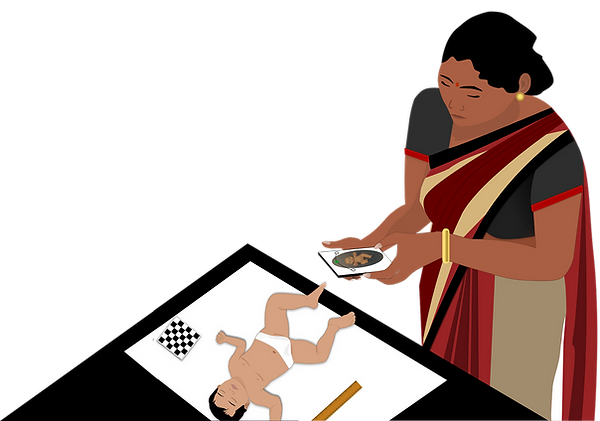
Wadhwani AI was building a mobile app that uses photogrammetry , a guided image capture that generates a 3D body model, so frontline healthcare workers can estimate an infant's weight without a physical scale. The ML couldn't work unless the field agents could get the motion right to capture the right frames.
11,000+
Lives reached through the redesigned capture workflow
67%
Accuracy lift
90%
ASHA's prefer the new design
CONTEXT
A sophisticated AI model. A workflow that kept breaking.
Photogrammetry was meant to replace traditional weighing; cumbersome and error-prone in community settings. Despite the Machine Learning (ML) model underneath, ASHA workers struggled to capture usable images. That dragged down model accuracy, worker confidence, and the program's ability to scale.
DID YOU KNOW
Accurate weight monitoring in early childhood is strongly linked to long-term health outcomes and plays a significant role in national public health and economic development.
The challenge was not simply improving usability. It was about designing a human learning system around a highly technical AI workflow.
MY ROLE
Interaction & product strategy
Diagnose
Led the diagnosis of breakdowns between the AI capture system and real-world field behavior.
Define
Set the core hypotheses on user error, embodied movement, and multimodal guidance, translating field constraints into product behavior.
Validate
Worked with engineering so interaction changes were measurable through device sensors and model performance metrics.
STRATEGIC REFRAME
We were solving the wrong problem.
The team knew there was a usability problem. What wasn't clear was what was breaking, or why. No one had deeply studied the ASHA workers themselves — their context, their relationship with digital tools, or what it actually meant to use a phone while managing a live infant in someone's home.

Embodied motion
Workers were asked to move the device in a precise arc around the baby ensuring no cropping, correct angles & depth. A physical, full-body task.

Rigid digital frame
The app screen showed a rectangular viewfinder with square framing, built on digital-first assumptions.
The shape of the task and the shape of the interaction were in direct conflict.
"
"How do we help frontline workers learn and confidently perform a new embodied digital behavior?"
How do we reduce user errors?
The task was phygital: embodied physical motion mediated by a digital interface. The problem was no longer usability alone. It was behavioral, instructional, and social all at once.
FIELD INSIGHTS
Six Broken Assumptions
We conducted ethnographic & observational studies and prototype testing with frontline healthcare workers to better understand:learning styles, interaction challenges, movement behavior, confidence patterns, social dynamics during adoption.

Interaction
Camera ≠ Arc
The original simple camera asked for an arc motion it never communicated. We need to anthropomorphise the frame to the infant so the screen matches the actual subject to be captured.

Community
Peer support vs Formal Training

Knowledge spreads through relationships. High-performing ASHAs often became informal mentors — adoption was being driven by community networks, not formal training alone.
Trust
Trust ≠ Not just the User
Parents often didn't know what image capture was, or how the technology handled privacy. Even confident ASHAs could be slowed by caregiver uncertainty. Trust had to extend past the first stakeholder (Asha's) to secondary (parents) & embodied in teh design

Learning Design
Training ≠ Learning
Workers given only training videos lagged behind those who got videos plus live, in-capture guidance. Learning happened through action and real-time feedback — not instruction alone.

Adoption
Adoption ≠ Competence
ASHAs adopted the tool fastest when it reinforced their expertise and made them feel more credible in front of families. Broken usability didn't just slow scans, it dented professional confidence

Language
Professional ≠ Everyday
Workers switched registers by context: clinical terminology for diagnosis, colloquial language for everything else. Interface copy and training materials should be shaped keeping both.

PRODUCT & INTERACTION STRATEGY
Five levers. One coherent experience.
The redesigned approach treated the workflow as a guided embodied interaction — not a data capture task. Five moves, working together: multimodal instruction, movement guidance, rhythm-based interaction, and a social induction mechanism rooted in how ASHAs already learn from each other.

Match the frame to
the subject
Replaced the rectangular bounding box with an oval shaped to the infant's body. The interface mirrored what it was capturing, not a screen convention.
Anthropomorphise


Make the invisible
path visible
A visual arc showed where to move the phone. Progress markers confirmed each capture point in real time — so workers knew it was working
Guide the motion


Voice-guided rhythm
"Ek… do… teen."
A simple rhythmic count - one, two, three - paired with key capture points along the movement arc. Voice gave ASHAs temporal guidance while their hands and bodies were busy. It also bridged the trust gap with parents, who could now hear what the worker was doing, and helped less digitally literate ASHAs navigate the app in their own language.
Contextual language
Icons and animations drawn from the ASHA's world, not generic UI patterns. Copy switched registers, clinical where precision mattered, vernacular where confidence did.


Animations & Illustrations

Social induction
Champion-led adoption
New workers were paired with a buddy ASHA in-app, with champion training videos surfaced during onboarding. The community was already mentoring each other - the design structured around it

Performance Signals
When capture quality dropped, the app prompted workers to practise , not just logged the failure. Poor performance became a learning trigger, not a dead end.
In-app nudges


QUALITATIVE & QUANTITATIVE EVIDENCE
Validated by sensors & vibes.
Working with engineering, we used device sensor data; including gyroscope-based motion analysis to measure arc consistency, motion accuracy, and capture quality across multiple rounds of testing and conducted feedback sessions with ASHA's on their preference.
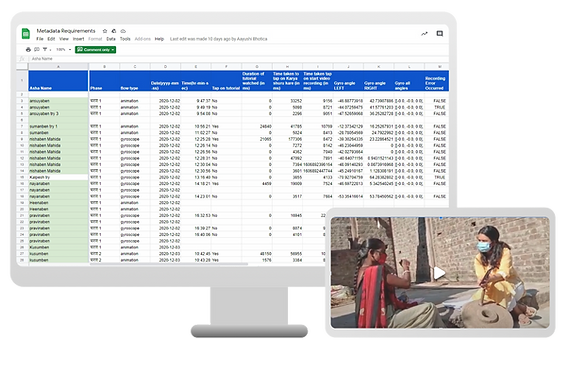

Img: Video captured by a frontline healthcare worker during user testing with one of the prototypes
RESULTS
Feedback from frontline healthworkers and
data anlysis of the prototype tests

67%
increase in capture accuracy vs. the original design, averaged across criteria

90%
of ASHAs said they preferred the new design with voice and visual guidance
"Earlier we didn't even know if the recording has started . If you give us this (pointing to prototype), we will like it. 'Yahi chahiye' (We want this)"
"
"The child comes easily in the centre of the frame, doesn't get cropped. The oval frame should stay"
"
"We like that we can communicate to the parents that the baby weighs less, or more -we prefer this version"
"
"Earlier I said I don't want to work in Wadhwani project. But after seeing this, I would like to"
"


Reflection
A framework for AI adoption in public health.
The project significantly improved the usability and learnability of the AI-assisted capture workflow.
More importantly, it helped establish a broader way of thinking about AI in public health systems, not as a purely technical problem, but as a behavioral, instructional, and organizational one. One that requires us to think 'people - first' for adoption and scale.

LETS GO DEEPER
What are you curious about?
How did you balance field insights with what engineering could actually build?
PROCESS
How do you frame AI tools to communities who may be skeptical or unfamiliar with them?
COMMUNICATION
What did your field research actually look like? How did you access ASHA workers?
RESEARCH
How would you scale this framework to other AI tools in public health systems?
SCALE
How do you handle the images of babies and the ethics around the data collection
PRIVACY & ETHICS
How do you measure something as intangible as trust in a system like this?
MEASUREMENT