by anandita punj
Designing & building trust in an AI farmer advisory system
A research-through-design to redesign a WhatsApp-based agricultural advisory bot - from a pest-management tool into a multimodal companion that mirrors how farmers actually communicate.
1.6M
FARMERS REACHED
5
COUNTRIES
8M+
QUERIES HANDLED
73%
FIRST TIME DIGITAL USERS
Overview
When reach isn't the problem, trust is.
Digital Green is a non-profit providing agricultural advisory services to smallholder farmers across emerging economies. Historically, advice flowed through local field agents — relational, trusted, but hard to scale.
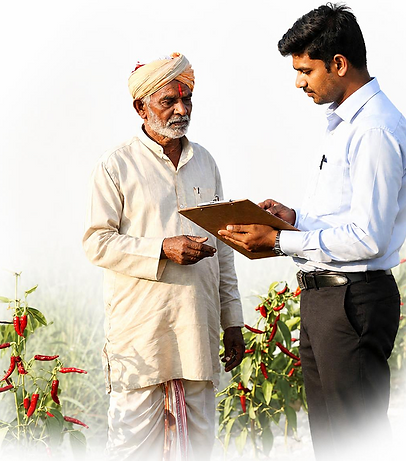
A WhatsApp bot was launched on the assumption that farmers already on WhatsApp would naturally engage. After launch, engagement stayed critically low.Field photo · placeholderField agent & farmer in conversation
The challenge was no longer about reach. It was about understanding why digitally accessible systems still failed to replicate trust, participation, and behavioral engagement.
"
I led product strategy and execution of a month-long conversational AI redesign, owning problem framing, experiment design, and multimodal system strategy.
Product strategy, research, multimodal system design.
Using Research Through Design (RTD), I translated behavioural insights into interaction principles that shaped the final system, coordinating client and development agencies toward a system deployed to 1.6 Million+ farmers.
My role

Research
Understanding how advisory actually works.
Studying farmer WhatsApp groups, peer-to-peer communication, and field-agent advisory interactions revealed how agricultural knowledge naturally circulates.
Pattern 01
Human advisory was relational, not transactional.
Field agents supported farmers through evolving questions and uncertainty. The bot was designed around isolated pest-management tasks, limiting opportunities for repeat engagement.
Trust is built through ongoing support, not task completion.

Typical chat betweeen a farmer and an agent - visual and emotive

Pattern 02
Advisory communication was deeply multimodal.
Farmers naturally used voice notes, images, emoji, mixed-language text, and video references. The bot assumed a text-first model, creating friction with real-world behaviour.
Interaction is intent-driven, not format-driven.
Pattern 02
Advisory communication was deeply multimodal.
Farmers naturally used voice notes, images, emoji, mixed-language text, and video references. The bot assumed a text-first model — creating friction with real-world behaviour.
Interaction is intent-driven, not format-driven.
Traditional Conversational AI or chatbots which are text heavy
Pattern 03
Advisory was artificially constrained to a task. Reality is more fluid.
Farmers moved fluidly between pests, weather, crop management, market conditions, and personal farming concerns, but the digital experience focused only on pest management.
Human advisory is naturally cross-domain; digital advisory is artificially narrow.
The problem wasn't distribution. The digital experience failed to reflect how agricultural advisory actually works.
"
Reframe
From pest-advisory tool to agricultural companion.
Three principles guided the redesign, each one addressing a gap between how the system worked and how advisory actually works.

01
Expand recurring value
Shift engagement from episodic to high frequency services: weather, seasonal info, market signals, farming tips.
02
Design for conversational familiarity
Match WhatsApp-native communication norms: emoji as intent, informal phrasing, reactions as input.
03
Enable multimodal interaction
Voice as primary, images for diagnosis, buttons for decisions, text as fallback. Adapt to mode, don't enforce one.
Experimental approach
Validated through staged experiments.
A two-phase experiment combined qualitative and quantitative research with measurable behavioral outcomes, testing assumptions before scaling.
Phase 1 | Manual Simulation
n = 30 farmers · Human-operated WhatsApp prototype
90%
of all interactions happened through voice
10x
higher engagement than previous bot at onboarding flow
Farmers frequently asked beyond pest management, especially weather, markets, and general farming questions
Phase 2 | Controlled Pilot
n = 200 farmers · Deployed system with full multimodal support
Voice dominated for open-ended questions; buttons for binary decisions; images for diagnosis
Weather was requested for multiple locations; farmers shared outputs with peers and farming groups. Utility and Value Added Services drive engagement
Farmers sent greetings, tested limits, asked unrelated questions; treating it as a conversational entity, not a tool

SYSTEM LEVEL FINDINGS
Four shifts that defined the system.
A two-phase experiment combined qualitative and quantitative research with measurable behavioral outcomes, testing assumptions before scaling.
01
Interaction mode follows intent complexity.
Voice dominated for uncertainty and open-ended questions. Buttons for deterministic confirmations. Images for diagnosis. Mode is a response to intent, not a preference.
02
Trust comes from multimodal continuity.
Farmers shifted between voice, images, and structured inputs within a single journey - mirroring how they spoke with field agents.
03
Utility services are entry points to advisory.
Weather consistently outperformed pest queries in frequency. High-frequency utility scaffolds lower-frequency advisory.
04
Engagement is conversational elasticity.
Farmers asked unrelated questions, sent greetings, tested boundaries. The strongest signal of adoption was deviation from the flow, not adherence to it.
What multimodal advisory looks like

The pilot proved it. The redesign scaled it.
Multimodality wasn't a feature, it was the condition for engagement. The interaction framework moved from pilot into production, now reaching 830,000+ farmers across India, Kenya, Ethiopia, Nigeria, and Brazil.
1.6 M+
USERS ACROSS 5 COUNTRIES
8M+
QUERIES RESOLVED
73%
FIRST TIME DIGITAL USERS
Conversational systems are not interfaces, they are behavioural environments. Engagement does not emerge from access to information, but from how naturally a system fits into existing communication patterns.
"

REFLECTION
From feature engagement to conversational elasticity.
This project reinforced that users do not interact with systems in isolated flows. They test boundaries, shift contexts, and gradually build trust through repeated, low-stakes interactions.
The interaction framework: voice, images, structured inputs, utility-led return; became the foundational design principles now shaping Digital Green's conversational advisory work across geographies
Flow with intent, not against it
Let the complexity / quality of a question determine the interaction mode.
Utility earns trust
Daily, low-stakes value creates the habit that makes deeper advisory possible
Deviation is signal
Off-script behaviour is adoption in progress, not noise to suppress.
From features to elasticity
The key shift was moving from feature engagement to designing for how freely users move in and out of intent, mode, and topic without breaking trust.
This scales beyond farming. Health, finance, education : the same tensions apply wherever digital fails to replicate human relationships.
"